
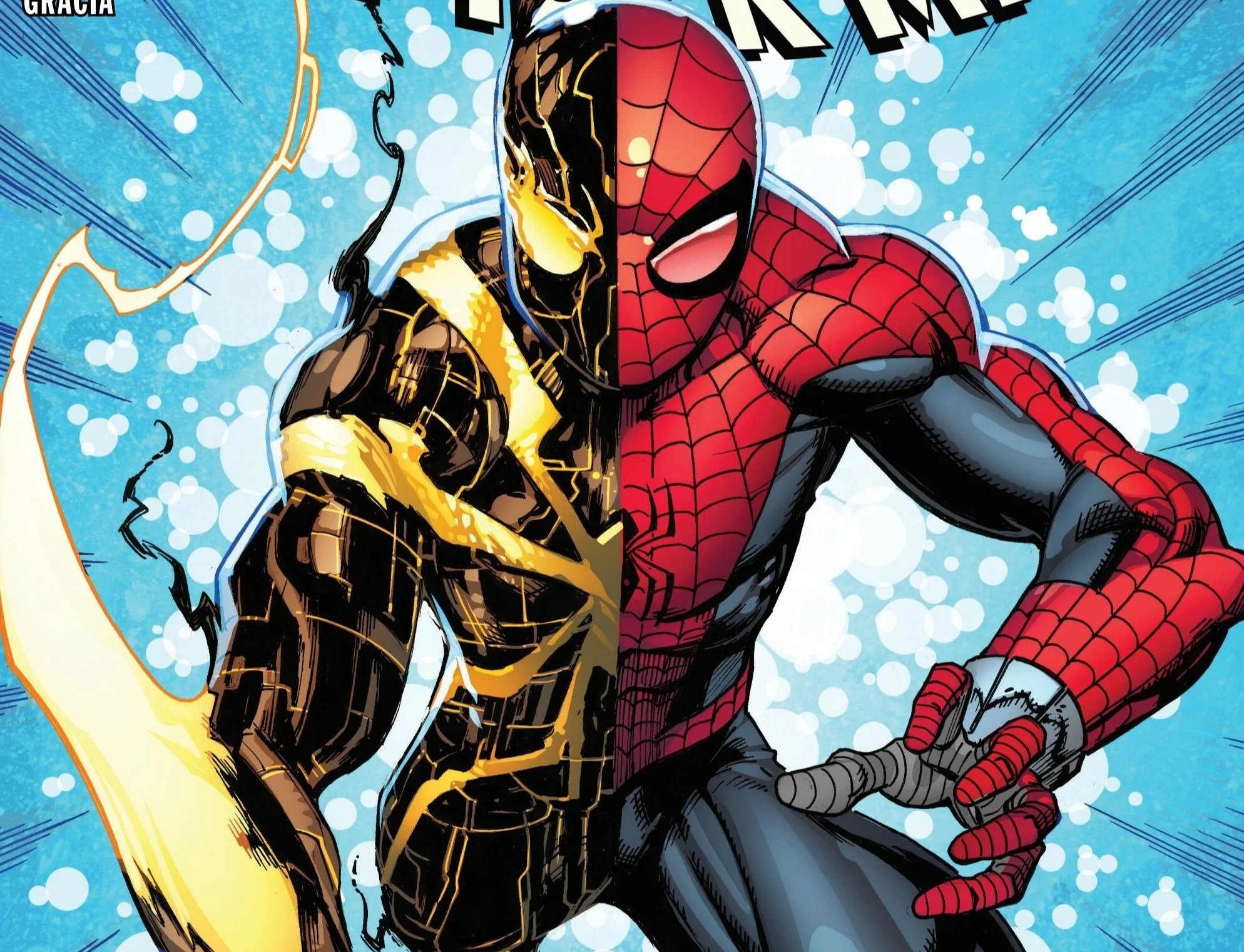
To be technical and nitpicky right off the bat, this is not even technically the actual homecoming of Peter. He is already back on Earth in the previous issue of Amazing Spider-Man as well as in the pages of the current run of Miles Morales. But for the sake of the precious little marketing conceit of Marvel, I will pretend those never happened.
So here we are, after nearly 17 issues of cosmic power-up quests, alien worlds, and a narrative literally torn between the earth and the heavens. Amazing Spider-Man #22 is positioned as the long-awaited return of Peter Parker back to New York City. This should be a pivotal moment. Peter Parker should be reclaiming his town and his relationships, confronting the fallout of his absence, and reasserting his identity as Spider-Man on familiar ground. Instead, what readers get is something quieter, messier, and far less cathartic than expected.
Issue #22 feels like a transitional issue masquerading as a payoff. It attempts to resolve far too many looming threads too quickly. It also sidelines them entirely for after the mandatory Marvel spring event. The issue sets up future arcs for entirely different books too bluntly. It spreads its focus across far too many narrative obligations to allow any single emotional beat to fully land. Yes, there are genuine moments of charm and character warmth here. Peter finally reunites with Aunt May, and there is the fun camaraderie he continues to share with Glitch and Raelith. But even these exist inside an issue that feels like it wants to rush through the formalities far too quickly to say anything of any real value right now. This shows in the writing and the mishmash of different art styles, which is a worrying new trend that seems to be plaguing recent issues.
He's Back! And Everything’s Whack!
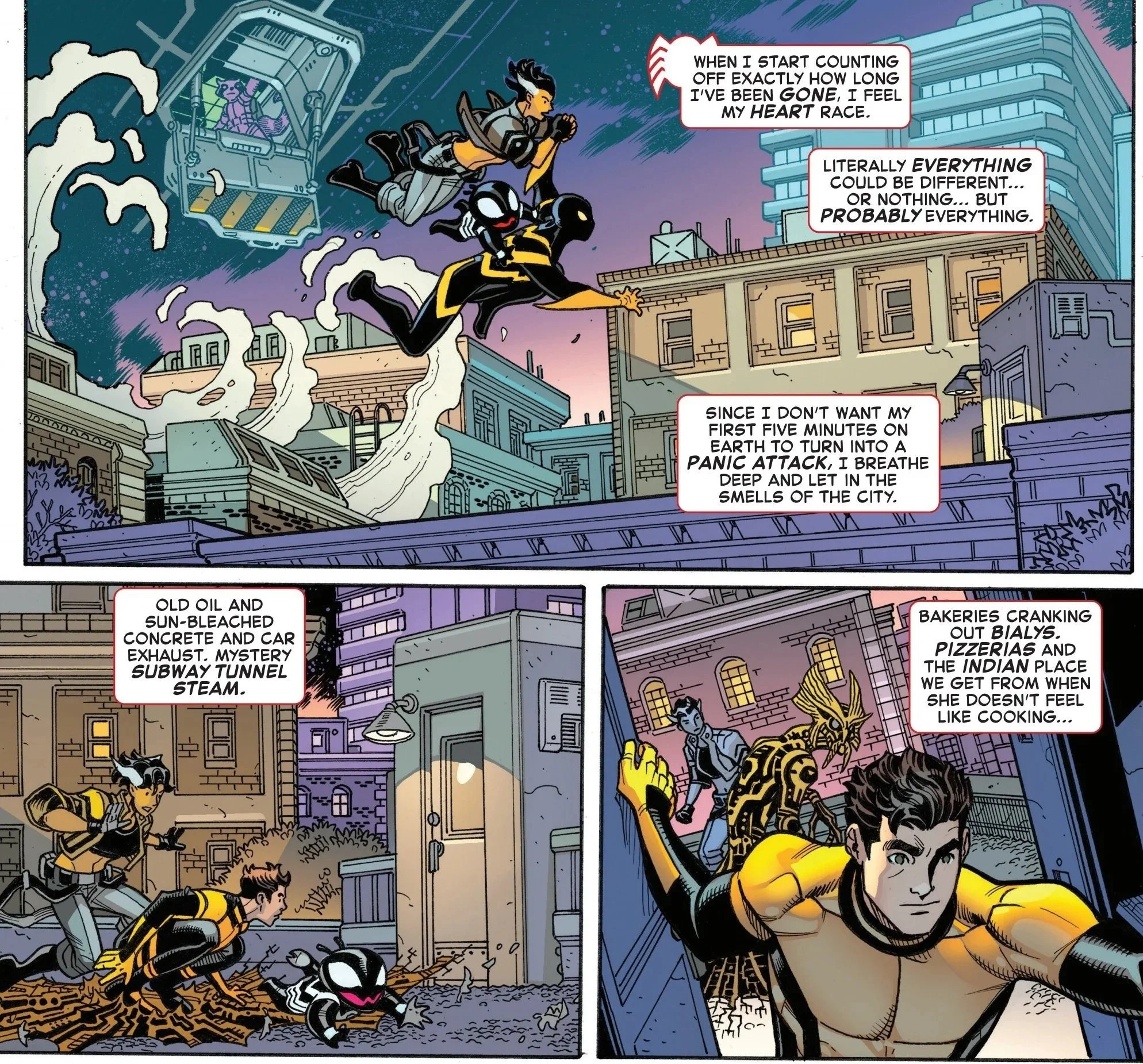
Despite having seen Peter giving Norman the pep talk he has always wanted to hear in the previous issue, it is actually here in issue #22 that Peter returns to Earth proper. Timeline shenanigans aside, Peter says his goodbyes to Rocket Raccoon, the mad scientist Xanto, and the nihilistic Niall before taking his leave. It is a touching goodbye, so to speak, but Peter is not alone in New York. Tagging along with him on his grand homecoming are Glitch, Raelith, and Symbie. That latter addition is surely going to have nothing to do with a suspiciously timed symbiote-centric event that is coming in a few days.
The first instinct of Peter is to find Aunt May, but of course, she has moved out and into some new digs with her current boyfriend. Since Peter does not know this, he instantly goes into panic mode before he finds the truly heartwarming letter that Ben Reilly left for him in his apartment. Naturally, Peter takes this in the most understanding way possible, which means not well at all.
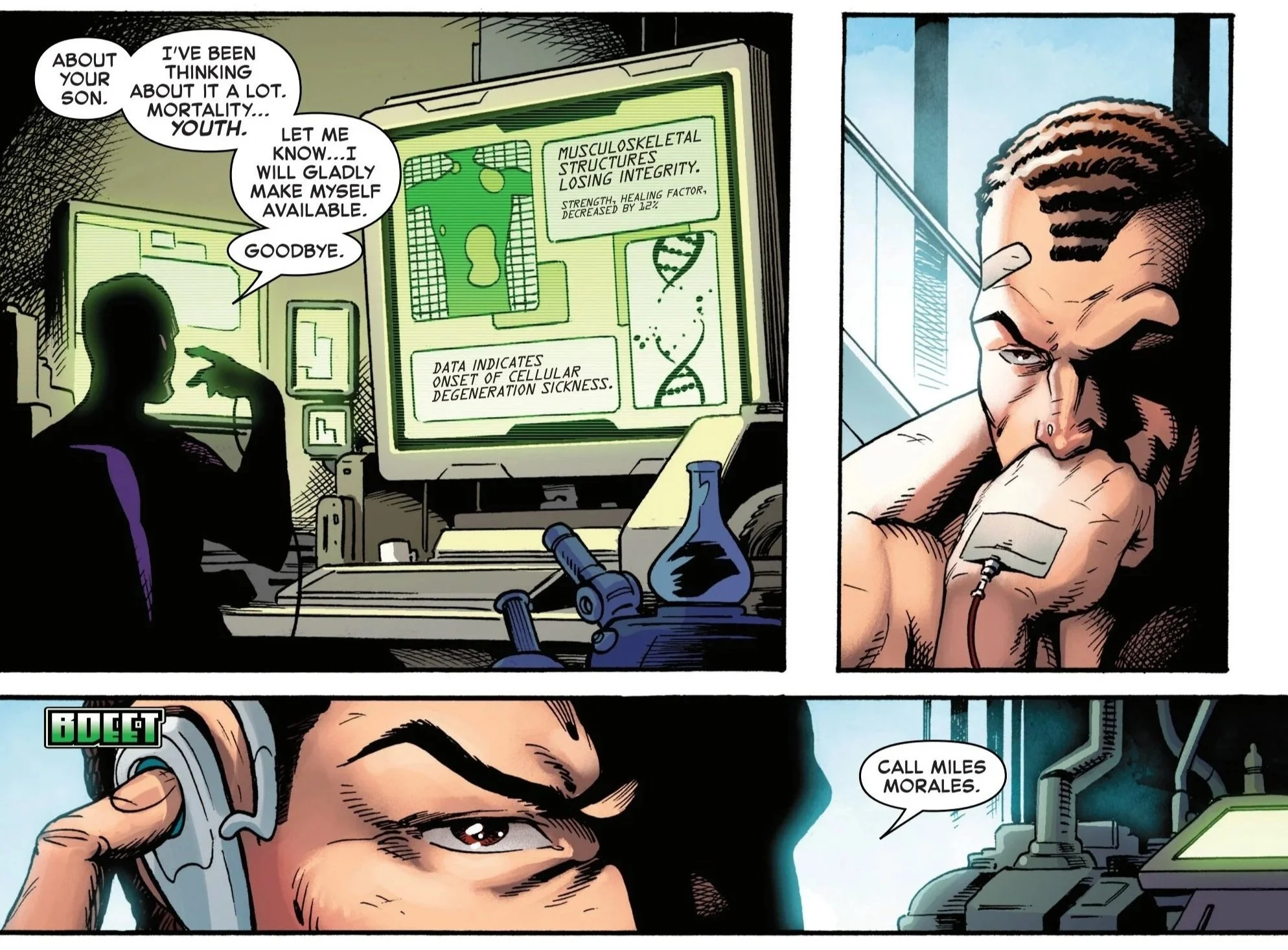
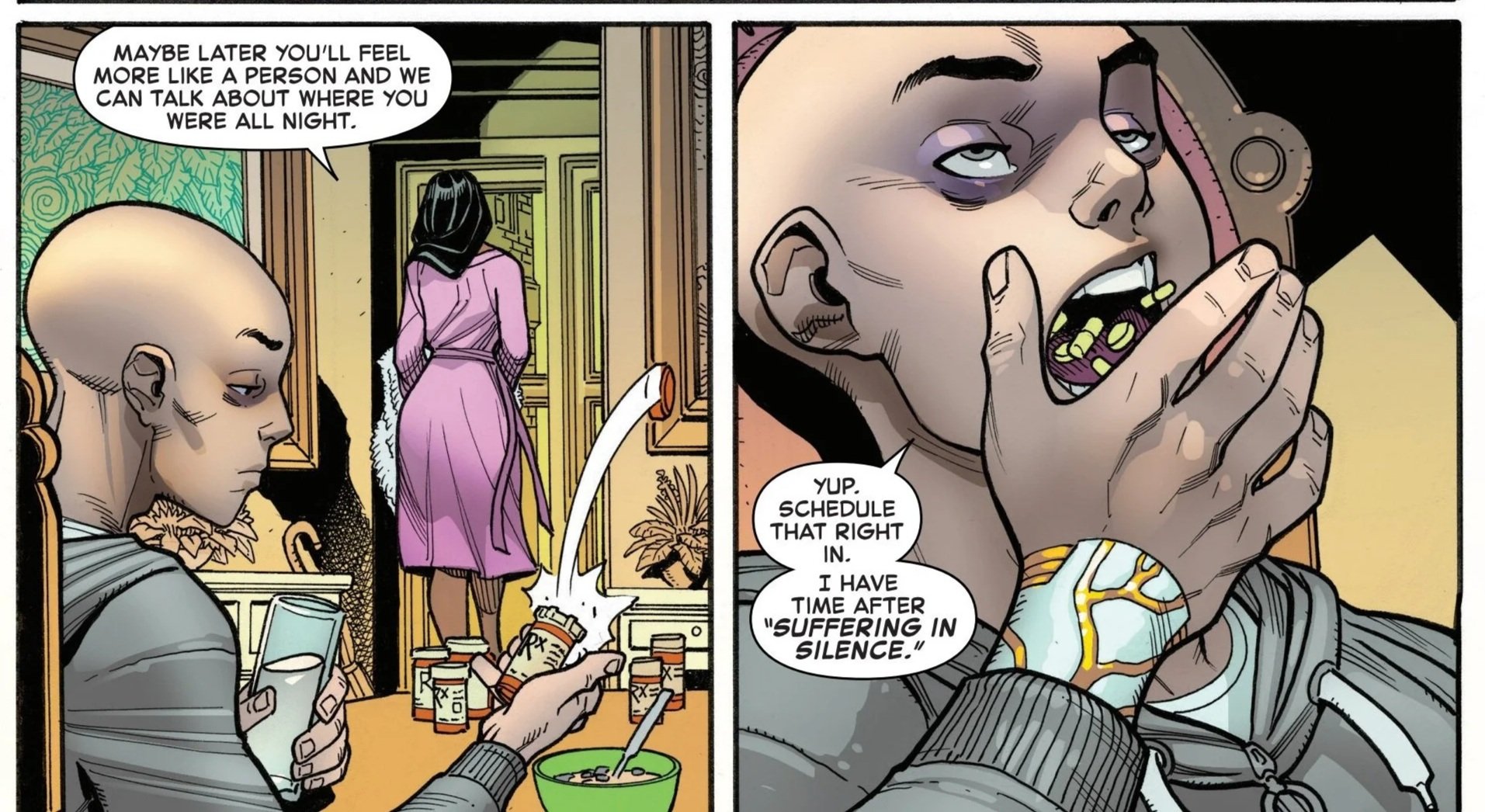
Meanwhile, we have a few spinning plates with our extended cast as well. Maria Osmani Milton of Rand Corp is dealing with her own fallout from the recent Spider-Slayer attacks, and her other employee nearly being killed in an experiment. All of this is happening while she is juggling a sick kid with an attitude problem. This naturally leads her to find solace in the wise words of Norman Osborn. Meanwhile, the kid in question lets slip an interesting visual reference tied to one Captain Kintsugi, who has been out and about since the start of the run. On that same note, Norman himself seems to have taken both a great interest in the health of the kid and some future ideas about Spider-Team-Ups with Miles. This clearly serves as a cue for a new book idea.
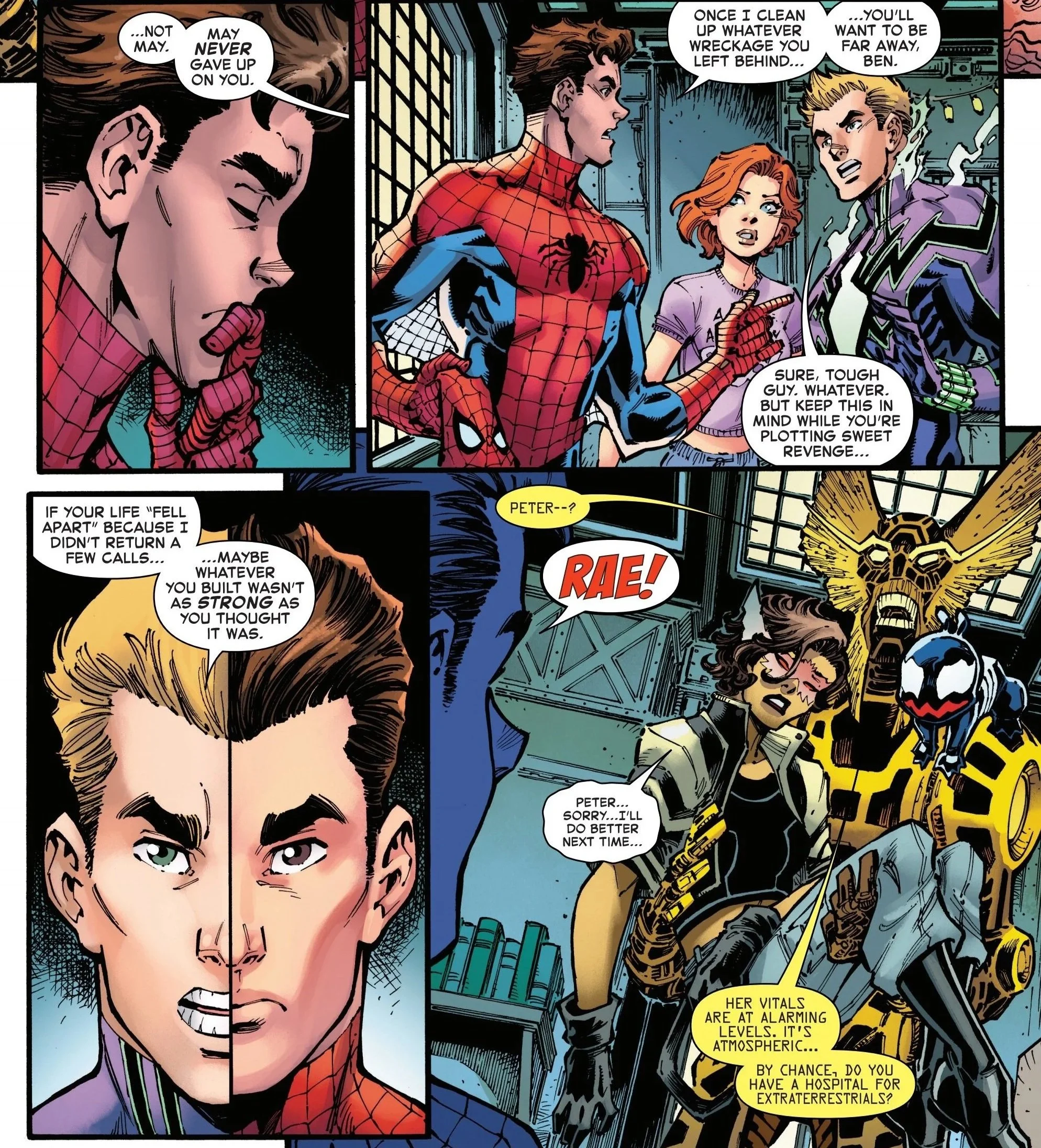
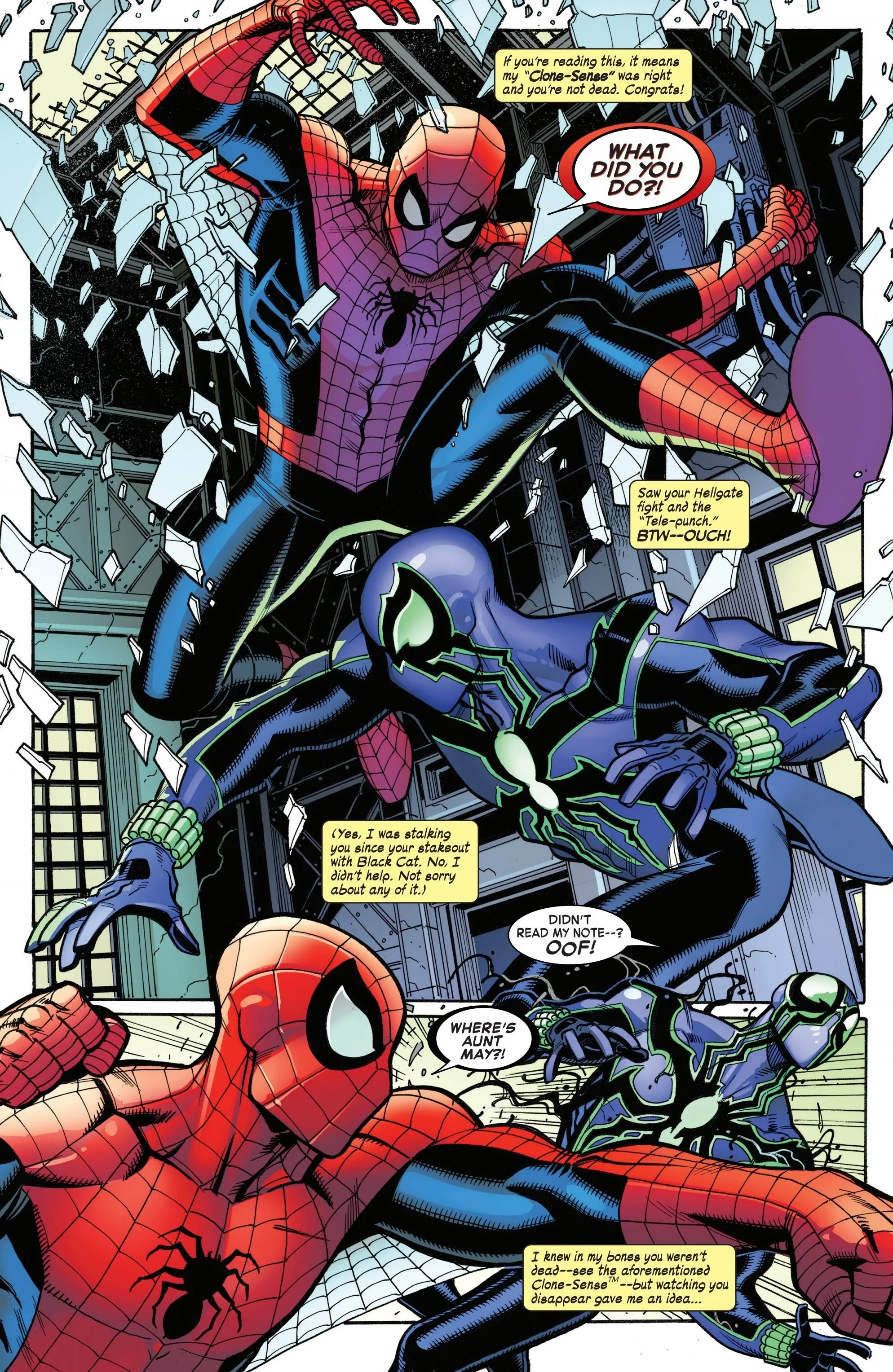
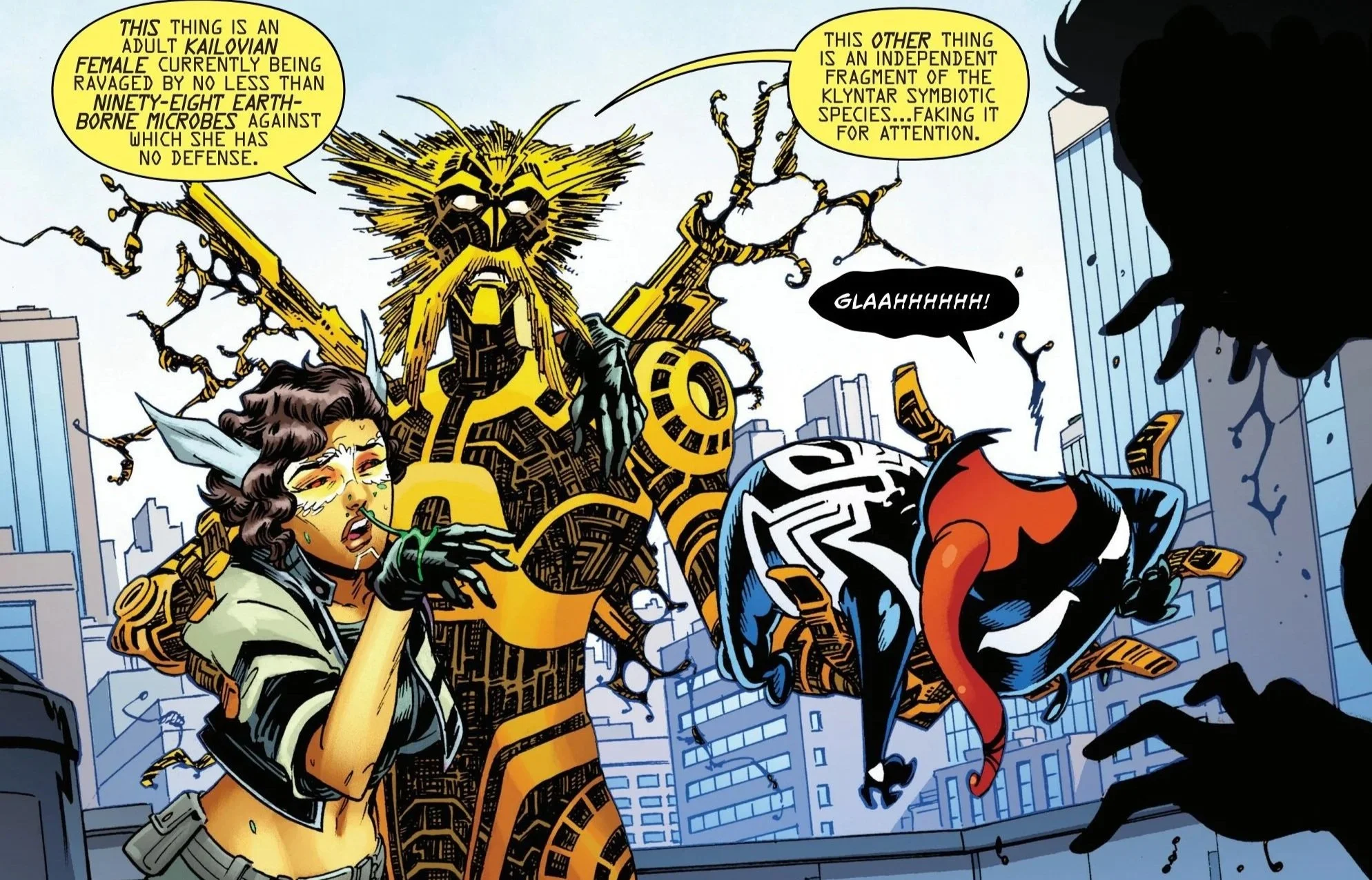
After finally tracking down Ben Reilly and having a perfectly civil conversation with his fists regarding the handling of the life of Peter, the two engage in some good banter between brothers. It turns out that the alien companion of Peter, Raelith, is not really vaccinated against the millions of Earth microbes. It is funny how that does not seem to happen as often as it should in these stories.
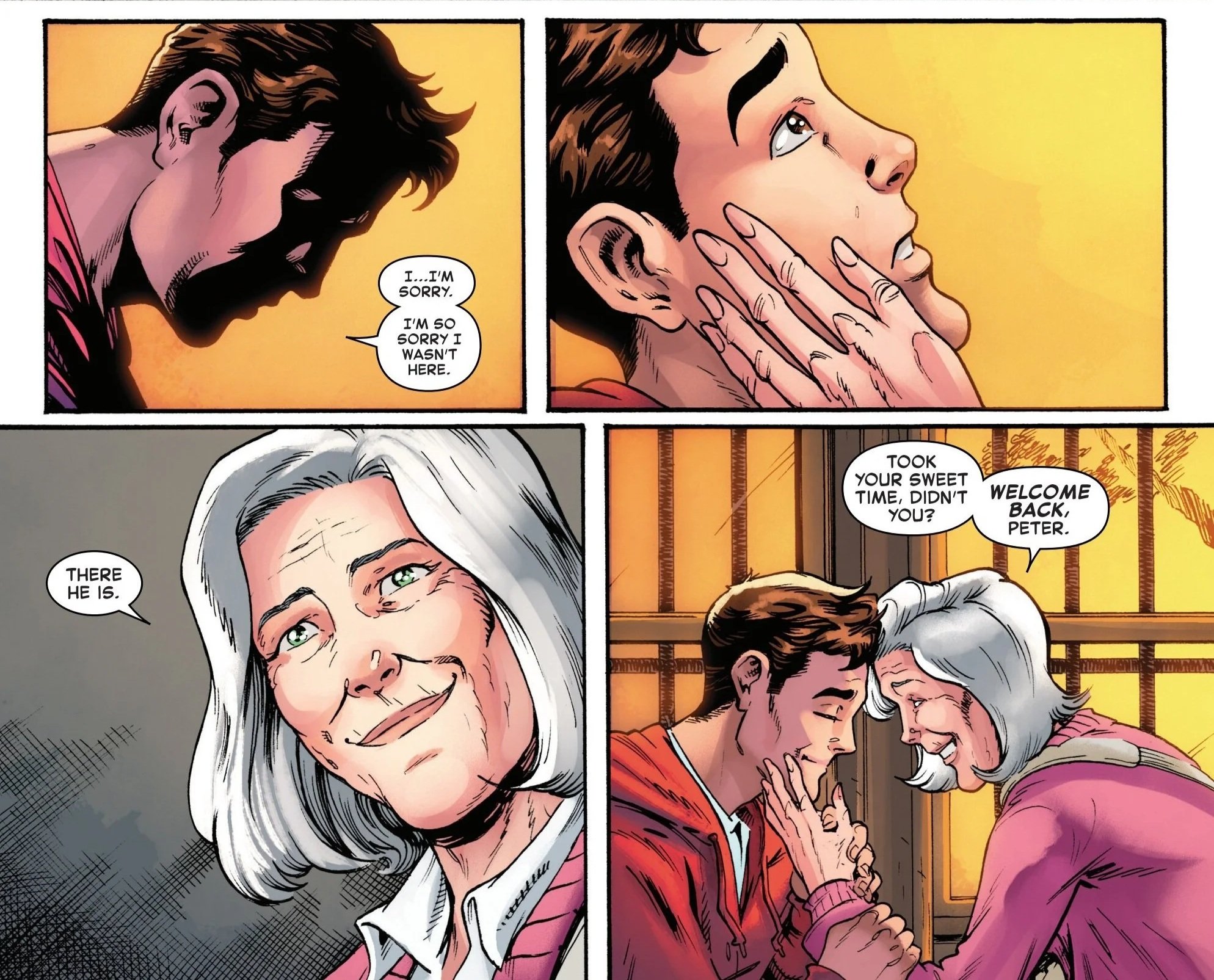
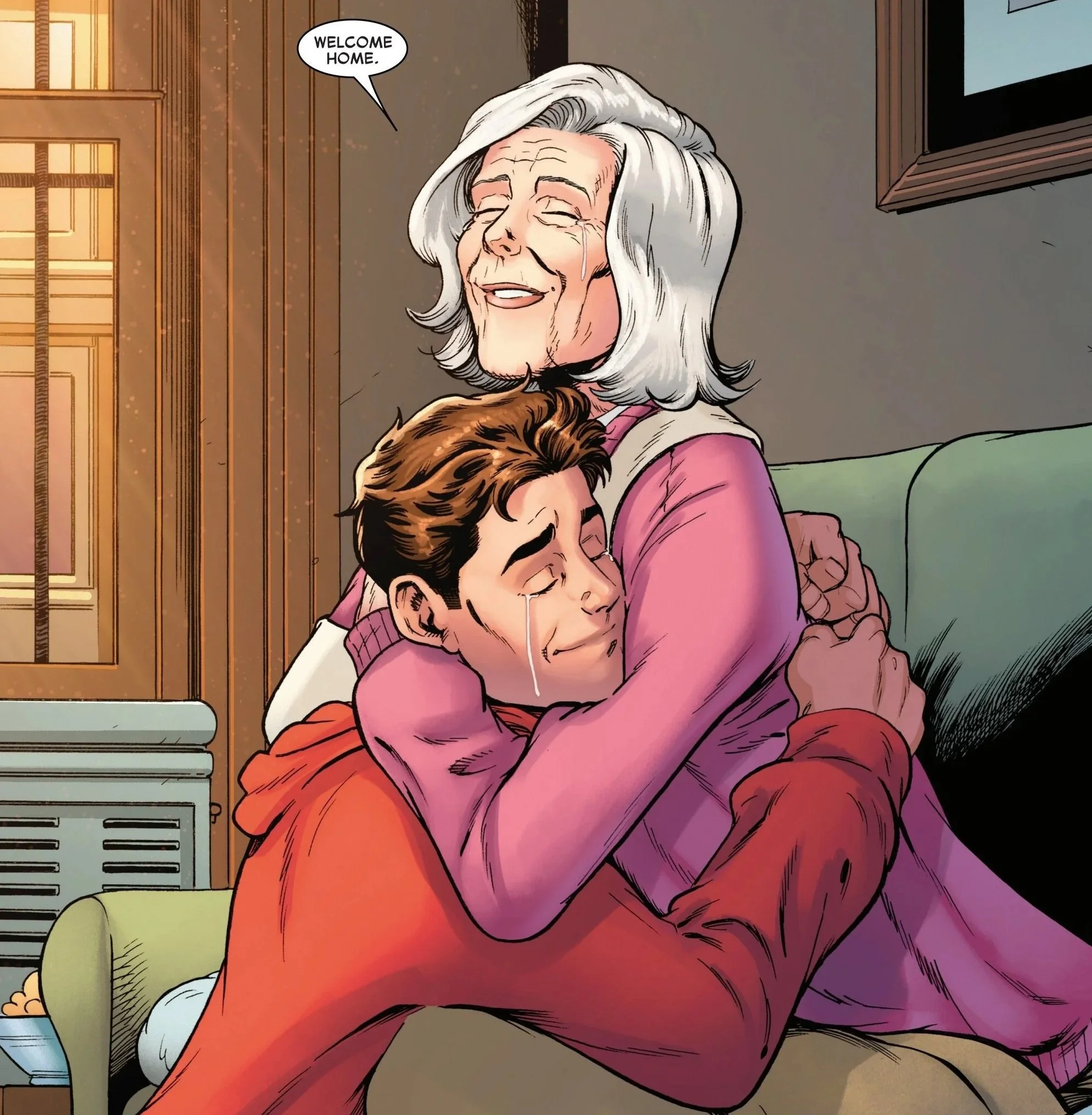
Because of this, he sends Raelith and Glitch off to the Fantastic Four to help out with her healthcare. Meanwhile, Peter heads off to the new place of Aunt May. After meeting and almost being kicked out by her new boyfriend, Ric, Peter finally meets his aunt. He tries to explain away his usual life choices, and Aunt May does what she does best. She forgives and loves her nephew all the more to close the issue.
From Homecoming to Homewrecking
Honestly, and brutally so, Joe Kelly has somehow written a return without reflection. The most glaring issue with issue #22 is that it never truly pauses to explore the return of Peter. After such a prolonged cosmic detour, readers reasonably expect a chapter that allows Peter to process his absence, reacclimate to Earth, and reconnect meaningfully with his life. You get a small smattering of this with Peter breathing in the scents and sounds of New York on his return, but that is so swiftly brushed aside to rush along the next arc. It is almost infuriating. Instead, the script moves briskly past introspection. Emotional beats are introduced but rarely linger. Peter is back, but the story treats this more as a logistical necessity for future plots rather than the emotional character moment it is supposed to be.
It is exactly this absence of reflection, which then chooses to focus on far too many other plot points that are not directly tied to the current shenanigans of Peter, that undercuts what should have been the emotional core of the issue. I say this with full confidence that Joe Kelly could have written an issue centered around the return of Peter and sat with his emotions properly. He did this effectively with the Norman and Jonah table sit-down issue. But this left things severely wanting.
One of the most dramatic scenes of the issue involves Peter confronting Ben Reilly over taking over his life and over the absence of Aunt May. This is bound to be particularly divisive, and not without reason. Peter's decision to maddeningly attack Ben is portrayed as impulsive and driven by fear, but the execution makes the reaction feel disproportionate and regressive. I personally completely understand this turn simply because Ben has not exactly endeared himself to Peter over the last few years. Since he became Chasm and tried on multiple occasions to take over his life in more nefarious ways, the tension is understandable.
However, I get why people would feel that instead of reading as raw emotional vulnerability, it reads as narrative contrivance. It feels like a forced conflict designed to manufacture drama rather than organically evolve it. Given the long and tangled history between Peter and Ben, this confrontation should carry tremendous weight. When it does get resolved and they put their fists away, it is not emotional or even revelatory. Instead, it unfolds quickly and makes Ben look utterly petty and childish. This happens even though there are some small inklings of him having been relieved that Peter was not dead during his absence.
Ultimately, the entire conflict resolves itself conveniently and without meaningful results because Raelith gets sick. Peter dumps her on the Fantastic Four to instead run off to find Aunt May. While Ben seemingly brings up how nothing has really changed in the relationships of Peter, even that is kind of hand-brushed away. To put it bluntly, any and all tension dissipates almost as soon as it ignites. This is emblematic of the broader problem of the issue. These are high-stakes moments that are quickly introduced and just as quickly thrown to the wayside by Kelly.
Perhaps the most frustrating aspect of issue #22 is the sense that the character arc of Peter stalls rather than advances. After so many issues of him gallivanting in space to overcome his defeat at the hands of Hellgate, I was maybe expecting Peter to return changed in subtle but meaningful ways. Instead, his behavior near-instantly reverts to reactive instinct. His mistrust of Ben escalates almost immediately to manic degrees. Again, this is not inherently unrealistic, considering the recent history of Ben and the deeper anxieties of Peter Parker. However, in context, it reads as narrative stagnation or even regression. The cosmic arc implied some degree of growth, and I am sure some of that will show up in the following issues. But this issue does not demonstrate it at all. This feels more like a reset rather than an evolution.
Despite these structural issues, issue #22 contains some flashing diamonds of sincerity. Peter's goodbye to Rocket, Xantu, and Niall feel genuinely heartfelt. They speak to the camaraderie they have built. His affection for Glitch and Raelith also carries this forward and reinforces the relationships he has built during his journey through the stars. As mentioned before, the first few panels of Peter returning to Earth, where he simply exists, feel like the most homecoming this issue will ever get.
Even the Fantastic Four cameo injects a welcome sense of grounding familiarity, though I would be wary of trusting any female alien friends around an intergalactic enthusiast like Johnny Storm. There is also some merit in finally clarifying the actions of Ben during the absence of Peter. While the explanation may feel convenient to some, it at least addresses lingering confusion. It has a small degree of concern for Peter. But the biggest moment is Peter finally reuniting with Aunt May. In probably the grandest moment of the issue, Aunt May does what she has always done without it ever feeling out of character or contrived. She accepts Peter back into her life, warts and all. It is a genuinely tearjerking moment. It is done perfect justice by the art and speaks perfectly to what is at the heart of the Spider-Man story. Again, these are not insignificant strengths. They simply feel underdeveloped.
I think the greatest problem with issue #22 is that the creative team attempts to set up so many things far too quickly, without any breathing room. You have Kelly trying to clarify the role of Ben during the absence of Peter, while addressing lingering interpersonal tensions between Peter and his missing Earth cast. He is also including supporting cast appearances for their respective stories, and finally, resetting the board for the Death Spiral arc. At the same time, the script is advancing other potential spin-off books.
Each of these elements could sustain its own focused chapter. But, when combined, they create a haphazard mess where no subplot is given enough oxygen to feel fully realized. The result is an issue that feels far too busy, rather than cohesive. Simply put, the book does not feel incomplete; it feels overstuffed.
The ambition of the creative team is clear, but the execution suffers from a lack of focus. When every page is fighting to establish a new status quo or tease a future event, the immediate story of the return of Peter Parker becomes a secondary concern. This is a disappointing outcome for a milestone that should have been the emotional peak of the current run.
When the Art is the Issue, But the Issue is Full of the Art
This was the part I was really worried about writing, because honestly, I am genuinely sick of this constant shift in visual style in the middle of issues. This is a problem that has been rearing its ugly head across the last three chapters specifically. While it fit narratively in terms of dividing Acts 1 and 2 in the previous issue, here we once again see a baffling lack of consistency. The presence of multiple pencillers, including Nick Bradshaw, Todd Nauck, and Nathan Stockman, results in tonal shifts that are noticeable from page to page. This is even more apparent because there is no real rhyme or sequence to the transitions. While none of the artwork is outright poor, the lack of a unified aesthetic direction undermines the emotional flow by a significant degree.
The reunion of Peter and Aunt May is a beautifully drawn sequence, and the art really sells the moment on a deeply emotional level. Similarly, the fight between Peter and Ben is not awful, and it does bring some much-needed energy to an otherwise quiet book. A hilarious panel with Glitch and company meeting the Fantastic Four is also given levity. The color work by Marte Garcia and Michelle Rosenberg also elevates the panels in a colorful mix of action and adventure befitting a Spider-Man title.
However, for whatever reason, the choice to switch up artists randomly across pages undercuts the individual skills of each of the three respective artists. I genuinely wish they would instead give them showcase issues of their own, instead of whatever this is. Because in the end, while the art may serve the story competently, it does the opposite of elevating it. I think this is a genuine insult to the kind of great line and color work this team can do if given the proper direction.
The Rent is Long Overdue
Bluntly put, Amazing Spider-Man #22 is a frustrating and uneven milestone issue. While it should carry the emotional weight of the long absence of Peter, and does so with his interaction with Aunt May, it instead chooses to shoulder the narrative burden of multiple dangling threads and the marketing weight of an impending major crossover. Ultimately, it does not manage to unite any of these into a fully satisfying chapter. Instead, the book feels like a return without a real homecoming, and it settles for being a transition that does not seem to have any real fixed direction in mind. Coupled with the genuinely frustrating mix of art styles, which is now seemingly indicative of the chaotic and even careless nature of this series as a whole, things do not look as sunny as the occasion should be.
The payoffs of Peter's big return, whether emotional, narrative, or dramatic, are either rushed or deferred. This creates a sense that this issue exists to move the story along, rather than to stand on its own merits. For die-hard readers who waited for this moment for a long time, there are small positives regarding the warmth Peter has for his space-friends and his aunt. There is also the appeal of the typical struggle to sort out a mess, which has kept Spider-Man comics as a frustrating yet addictive soap opera for readers.
For others, however, the recurring pacing pains, the constant changes to art styles with no real intent, and the character regression make issue #22 feel like a flat and anticlimactic waypoint rather than the pivotal chapter it could have been. It is a dark reminder of some of the worst things readers have had to put up with throughout the series. As we veer closer to another event in Death Spiral, these problems will inevitably be brushed under the rug to serve event-based shenanigans instead. Peter Parker may have landed back on Earth, but the problem is that the landing barely registers.
Final Verdict: Amazing Spider-Man #22 feels less like a heroic homecoming and more like a mandatory setup issue where readers are spoon-fed information on future titles while Peter scrambles to competently handle even the most basic of follow ups since his absence.